
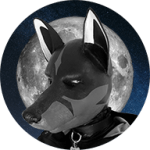
This page contains furry species created by a prior integrating form of Latex G.N.R. Space-Coyote (i.e., <RÆH|牙|K1B4>, AKA: kiba). While kiba’s furry is a wolf, over time this has become more vivid through life experiences and slow reveal of talents and abilities that have emerged more visible over time.
Chrono lupus
These are a species of wolves that had evolved due to parapatric speciation operating on Canis lupus, where continued selective pressures triggered epigenetic modifications which later resulted in genetic predispositions and then genetic alteration.

Seeing potential in speculative modifications to C. lupus, protogen observers pushed for further artificial speciation by working over a period of time to genetically modify earths’ wolves to give them a better chance at restoring balance (i.e., homeostasis) to ecosystems pressured by byproducts of anomalous forms of beings. To protogen observers, H. sapiens was misunderstanding their role as a membrane steward rather than seed producer. The membrane earth entire was necessary, rather than the seed isolate H. sapiens.
A by-product of protogen interference amplified latent abilities developing in wolves wherein biological capabilities to fold spacetime had been emerging. Speciation already emerging through natural and artificial selective pressures, with Protogen assistance, had resulted in a new species through “genus inversion”1: the Chrono lupus. Due to their abilities, high degree of self- and social- awareness, along with their keen sense of independence, and innate sense of ecosystem balances, they remain hidden to avoid detection.
Chronolupine “Gifts”
Chronolupine Graphite Armor
“Chronolupines” have several “gifts” from protogens. First is armor that attenuates unstable folding behaviors latent in their biology which cancel out most warp effects. This armor preserves energy expended during unstable warp fields, and instead, redirects energy toward stabilized folds resulting in greater fold distances (i.e., fold amplification). It is this fold amplification responsible for recognition of warp-field effects. The armor appears like dragon/fish scales with independent vector actuators that alter tiling to redirect instabilities in warp fields. The armor is graphene impregnated rubber, which combines organic materials of spiritual meaning for chronolupines appealing to traditional authority in their cultures along with technological authority of graphene when used as a moderator in a vehicle of topologically alterable rubber.
Chronolupine Warp Navigation
The second “gift” of the protogen is a modification to sociological framing of warp field effects. Due to popular media being influenced by early conjectures on warp field phenomena, protogens worked to overcome this framing with chronolupines capable of large to massive lexicons and understandings of scientific methods. The alteration of the framing of warp field causes-effects gave Chrono lupus a head start against market interests in warp technologies; the knowledge of these effects and their application is located in a science called warp field mechanics and warp navigation. In possession of these skills, the third and final ”gift” therefore was aimed at defense.

Chronolupine Protogen Shapeshifting
Chrono lupus had ability to not only fold spacetime, stabilize the folds for greater effects, and knowledge of folding cause-effects to aid in application, but knowledge of the potential perceived impacts ecologically. The combined abilities and knowledge had been perceived to directly threaten governmental authority in regulating markets and predictability of participant (voluntary or coerced) behavior. Their exposure was deemed a danger and as such, they had become a protected species by early protogens that had become aware of and aided their evolution (Unit 38B).
Protogens offered to mask Chrono lupus as protogens, while secretly merging their own technological enhancements with Chrono lupus in search of beings that could better traverse the edges of the known galaxy in furthering their exploration. While protogens typically are modified during development, chronolupines had an ace up the sleeve. Chronolupines discovered their ability to fold and de-fold their bodies to/from protogen appearance without permanent changes during development. This ability to mask as a protogen meant secrecy through obfuscation. Though this seems advantageous, due to the high levels of cognitive skill, metabolic needs, and continued effort maintaining “switch-like” folded forms, working memory and cognitive load is extremely taxed in their “protogen” form. This taxation in protogen form results in a state where they appear less than highly intelligent, and in some cases their outward behaviors may seem mildly to severely intoxicated, depending on skill. Some chronolupines have demonstrated euphoric states, and mistaken for gurus or suffering savant syndrome, while maintaining protogen appearance.
There are advantages that offset downsides of chronolupine protogen form. First is the ability to “fire and forget” a warp navigation plan prior to protogen form activation. In effect, the chronolupine can (a) activate a situationally-modifiable warp plan out of a wide array of plans continually salient based on current conditions, (b) activate protogen form, (c) ride out the plan’s activation during intoxication, and (d) arrive at the destination hopefully with little incident. These gambles in chronolupine creole are called “shots”, though on occasion are confused with shots of strong liquor or illicit substances which offer a good cover for those suspecting a chronolupine. Shots through extremely low probabilities of success had also been dubbed “fireballs” continuing the theme.

Chronolupine Psychology
Chronolupines are not pack-oriented outside of captivity much like their Canis lupus ancestors yet exhibit cooperative and coordinative behaviors up to a point. Their historical ecology naturally, and artificially selected for high flow state maintenance and a variety of psychological defenses to protect this state as it allows rapid study of measure (i.e., sensation), report of cause-effect, and increasing modification of reality (i.e., behavior). In captivity chronolupines do revert to pack-orientation as crisis response, though they would much rather not be subjected to pack-like hierarchies, authorities, and rigid structures with constrained social mobility. In captivity situations, chronolupines coordinate and cooperate in the alteration of spacetime to preserve increasing competency, autonomy, and relatedness in loose-ties while traversing social graphs for studies.
Chronolupines advert away from most leadership roles, though their abilities lead spacetime’s emergent outcomes—this is a known required tradeoff to influence reality. The reason for avoiding leadership is oft reasoned as “dangerous”, though there have been chronolupines occasionally taking leadership roles in constrained environments (e.g., captivity), which artificially situate leadership identities in the pack wherein effort to restore freedom brings a swift end to typical display rules of leadership resulting in queer behaviors.
Something unique to chronolupines is an unmatched insight into birth and death. Chronolupines do not fear death, period. However, they may fear loss of benefit much like many intelligent species. Chronolupines look forward toward death, though do not rush it, as it, to them, is no different than ”moving apartments” or ”moving cities”. As chronolupine culture rejects hierarchies, markets, and captivity, their culture does not use or employ reasonings to coerce fellow chronolupines away from death’s door. If a chronolupine is continually successful in maintenance of homeostasis, their belief is that they will arrive ”precisely” where they are most helpful, not through serendipity, but something only understood through proper framing of warp capabilities.
Chronolupine Appearance
Several characteristics are demonstrative of chronolupines, namely their anthropomorphic wolf-like appearance, multi-colored long mohawk from their forehead, between the ears, depending down the back of the head, and down the neckline. This mohawk may evidence some solid colors like black, blonde, or even singular colors. Some chronolupines evidence a rainbow mohawk descending down their entire back, though this is more rare. Some chronolupines evidence fox or coyote like appearances, though, not as often. As an aside, chronolupine engineers are oft more fox like, though this was just a result of further speciation due to isolation of engineers from other chronolupines during their genesis.
Chronolupines may have more Homo sapiens like hands and feet, though this is an anomaly that is oft artificially rather than natural. Chronolupines may alter paws, as maintained by warp field effects, to increase dexterity during delicate or precision efforts. That said, there are chronolupines that demonstrate extremely high dexterity with their paw-like hands with claws. Some chronolupines even domonstrate telepathic and telekinetic abilities, though these are rare and demonstrate the ability sparingly to avoid exposure.
As chronolupines use protogen gifts, they are oft not without their rubber-graphite armor, though they may opt to cover this up with “normie” clothing. Some find covering their armor revolting as in their native worlds, they do not partake in covering their armor, unless with equipment for purposes suited to additional garments and accessories (e.g., scientific equipment, harnesses, holsters etc.).

There are some chronolupines that have genetics convergent in providing warp stabilizing scaled armor biologically (i.e., natural armor)—these are extremely rare and covert. These chronolupines may exhibit dragon like traits, and due to their increased abilities tend to ”hoard” treasures not due to ”dragon like tendencies”, but due to their unique ways in which memories are organized atemporally. These chronolupines may have pointier ears, more coyote like muzzles, and an even more aloof personality.
Chronolupine Society
Chronolupines share a collective belief due to mutual excitement they share in their ability to fold spacetime. A shared belief system in not growth, but homeostasis is a deep part of the belief systems of chronolupines, though they outwardly reject codified belief systems so that they may better study belief systems of numerous beings. Due to their innate scientific sense, acultural beliefs, and effort at achieving homeostasis, their productive efforts in science lead to ideologies that sometimes may be fixated on homeostasis restoration without seeing benefits of larger swings across vast distances of spacetime—they oft are more fixated during captivity, which is where their weaknesses emerge from.
In terms of pressures leading to thought styles, chronolupines are generally less polarized in terms of a politeness-violence spectrum, which might evidence a more gruff, straightforward, and frank demeanor. That said, in confinement, they may internalize politeness-violence bimodal styling to their thoughts, feelings, and behaviors, and if captivity is of long durations, their traits may exhibit bimodality—this is oft easily remedied by release from captivity, though it may take time.
Regarding authority and markets, chronolupines does not support authoritative hierarchies or market exchanges, and treat them as forms of captivity. Chronolupine beliefs in homeostasis prevents assent toward authoritative systems, as to a chronolupine, the centers of distributions provide enough evidence of a quasi-authority along with scientific rigor in evidence provided by analysis and study. Armed with literature and [redacted], the ”authority” is evidence. As homeostatic management is part of chronolupine social identity, markets are only as helpful as the management of homeostasis, so their support for markets is replaced by logistics. No chronolupine goes unfed or uncared for and this is not a social compact, as principles of homeostasis assures fair and equitable resource distribution. That said, again, captivity can temporarily or otherwise alter chronolupine behavior back to non-ideal states where they may utilize markets to restore freedom from markets.
Regarding sexual relations and partnerships, chronolupines are generally not monogamous and share in couplings experiencing the joys and pleasures of sexual relations for study, enjoyment, replenishment, stress relief, and occasional reproductive needs. Chronolupines enjoy sex tremendously and are quite creative with it! Chronlupines enjoy many fetishes, and are not shy or embarrassed about them, except again, when in captivity.
They will jointly care for their young and share responsibilities. In many cases chronolupines will determine the most effective individuals for a youth’s stage of development and request that youth spend time with other chronolupines or members of other species (even plants and insects) to navigate stages of development. As chronolupines have a shared belief in ecological homeostasis, their beliefs on youth are to encourage an ecological awareness at a young age with diverse perspectives, even outside of their own species from birth.

Notes
1 Genus inversion is a proposed genetic phenomena whereby a “kink” in the phylogenetic tree of a species propagates in regions of genetic code more centralized to a genus’ genetic inheritance in both DNA and mtDNA along with situated selecting environs selecting for said original changes along with the genus inversion environs. In this case, genus Chrono is modified at the genus level to indicate this inversion. While losing fidelity, this inaccurate to original intent of linguistic syntax for species differentiation is more assistive to memory organization and speeds indexation.