

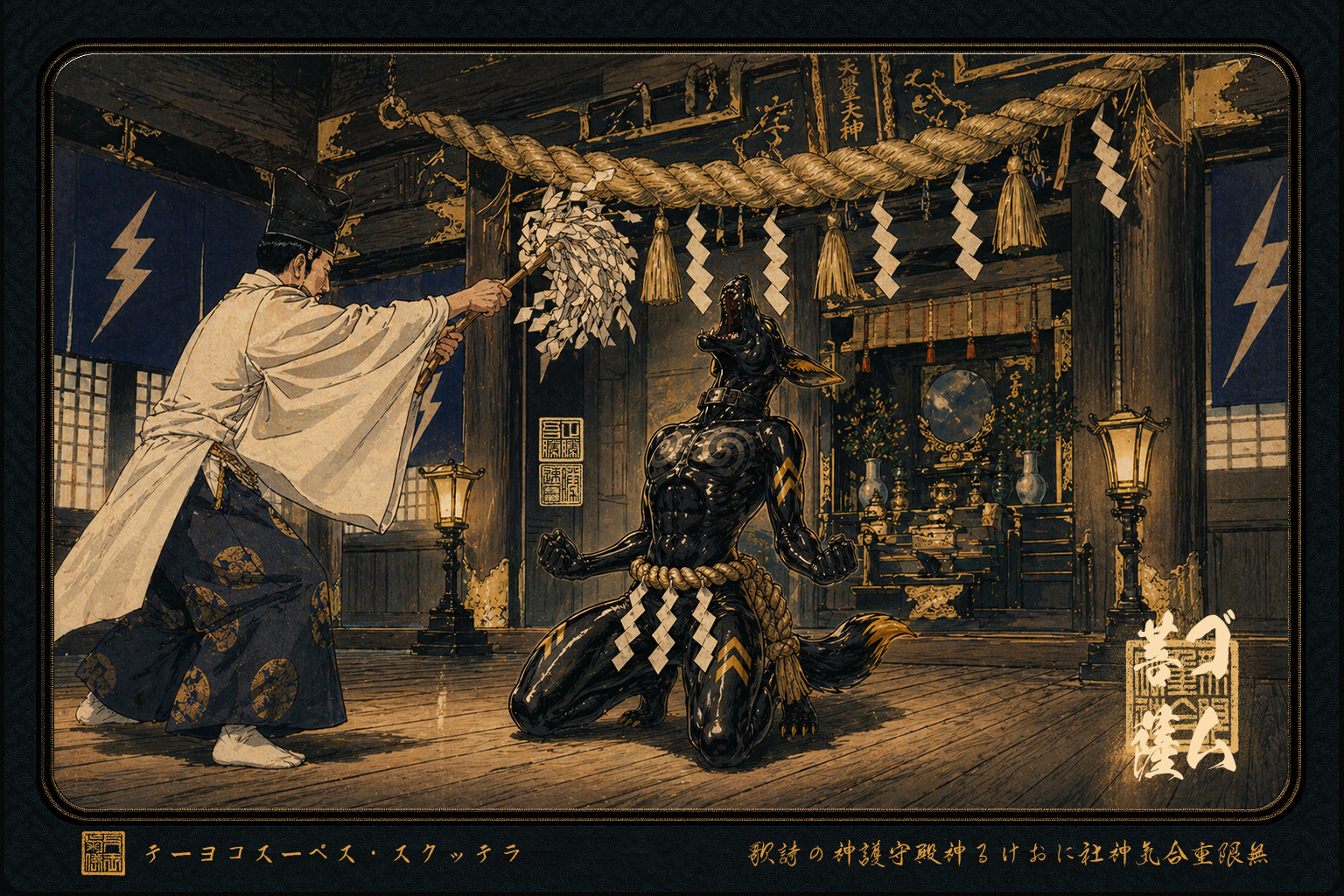
A rope is ordinary until its placement changes how a place must be approached. Paper is ordinary until it is cut, folded, hung, offered, or set in motion within a rite.
Shimenawa (しめなわ) and shide (しで) are therefore more than shrine decorations. They reorganize perception. A tree, stone, gateway, sanctuary, ring, or temporary enclosure is no longer encountered casually: attention changes, conduct changes, and relation changes. The material remains straw, fiber, cloth, or paper, yet its placement makes a ritual claim—here, something is set apart; here, approach must become care.
Musubi gives language to this relational work. Yet the word requires some care of its own.
Musuhi and musubi: Generation is not merely a knot
Modern explanations often translate musubi as “tying,” “binding,” or “creative joining.” That translation is useful, particularly when the Japanese word is written 結び (むすび), from musubu, “to tie” or “to join.” It also suits later religious language in which joining, harmonizing, birth, and creative relation overlap.
The divine names found near the beginning of the Kojiki, however, require a philological distinction. In names such as Takamimusuhinokami (高御産巣日神) and Kamimusuhinokami (神産巣日神), the archaic element 産巣日 or 産霊 is more precisely read musuhi, with an unvoiced h. Kokugakuin University’s philological survey notes that an older theory read the word musubi and derived it directly from “binding,” but that analysis of the phonetic characters used in the Nihon Shoki supports musuhi as the standard reading. In this early setting, the word points primarily toward production, generation, birth, and the power by which things come into being.
The two semantic strands should neither be collapsed nor torn completely apart. Later usage did allow musuhi to be heard and interpreted through musubi: generation could be imagined as a joining of powers, a fastening of spirit to form, or an accord through which new life appeared. Kokugakuin’s introductory account accordingly describes musubi through “birth and becoming,” accomplishment, combination, creation, and harmonization. The relationship is one of historical layering, not a one-step dictionary equivalence.
Throughout this article, musuhi is used when the archaic divine-name element is specifically at issue, while musubi is retained as the familiar modern term for joining, relational creation, and accord.
The distinction strengthens rather than weakens the article’s central claim. Musubi is not merely a finished knot. It is the activity through which distinct things enter a relation capable of producing something further.
What Do Shimenawa and Shide Mean?
Shimenawa (しめ縄・注連縄・標縄)
A shimenawa is a rope placed before, across, or around a site or object in order to mark sacred or ritually pure space. It may hang before a shrine sanctuary, stretch across an entrance, enclose a ritual site, or encircle a tree, stone, or other distinguished object. The rope is usually made from straw today, although hemp and other fibers have also been used historically. Shide may be suspended from it.
Several traditional written forms of shimenawa convey the senses of marking, enclosing, or restricting. Yet “restriction” does not always mean absolute prohibition. Some ropes guard spaces that ordinarily should not be entered. Others hang above entrances through which worshippers regularly pass. Still others encircle an object that may be approached but not treated casually.
A shimenawa therefore does not always say simply, “Do not cross.” More often it says:
This is not ordinary passage. Approach differently.
It marks a change in the conditions of relation.
Shide (紙垂・四手)
Shide are cut, folded, or flowing strips attached to shimenawa, branches of the evergreen sakaki, or ritual staffs. They are now most commonly made from white paper, but earlier forms used cloth, especially yū, a rough material made from the bast fibers of paper mulberry. They occur in several folding patterns and regional or institutional styles, including forms associated with Ise, Shirakawa, and Yoshida traditions.
Shide are often described simply as “zigzag papers symbolizing purity.” That is not entirely wrong, but it is too narrow. Shide do not possess one detachable meaning regardless of context. Their function depends on what they are attached to and what ritual relation is being enacted.
Attached to a shimenawa, they make a sacred border conspicuous. Attached to a staff as a gohei, they participate in the history of offerings and divine emblems. Gathered on a haraigushi or ōnusa, they become components of a purification implement. Attached to the ceremonial rope of a yokozuna, they contribute to the visible marking of exceptional ritual status.
Shide are therefore better understood as relational signs than as freestanding icons. They make a ritual condition visible.
Popular explanations sometimes compare their angular folds to lightning. That resemblance may be meaningful within particular modern interpretations, but it is safer not to present “lightning” as their settled or universal etymological meaning. Authoritative descriptions define shide principally through their material, construction, placement, and ritual employment.
This is an analytical reading, not a claim that every worshipper or historical source treats the three as a formal theological system. Their connection lies in what they do: they make relation perceptible.
Where do these ideas come from?
Textual witnesses, not simple beginnings
The Kojiki, compiled in 712, and the Nihon Shoki, compiled in 720, are among Japan’s earliest surviving mytho-historical chronicles. They provide foundational textual witnesses for musuhi kami, court genealogies, ritual narratives, and the ordering of the cosmos. They should not, however, be treated as transparent records of a single unchanged “ancient Shintō.” They are compiled works with literary, ritual, genealogical, and political purposes.
Near the beginning of the Kojiki, Takamimusuhinokami (高御産巣日神) and Kamimusuhinokami (神産巣日神) appear among the first divine presences. They are associated with the generation and unfolding of the world rather than with the tying of a literal rope. Their musuhi is the event of emergence—the power through which forms arise, develop, and enter an ordered world.
The rope enters another famous narrative: Amaterasu Ōmikami’s (天照大御神) withdrawal into the heavenly rock cave in response to Susanō-no-Mikoto’s (須佐之男命) attacks (destroying her rice fields, defecating in her palace, and flaying and throwing a revered horse into her weaving loom and accidentally killing a weaving maiden).
After Susanō’s destructive acts, Amaterasu closes herself inside the cave now called Ama no Iwato (天の岩戸), and darkness overtakes both Takamagahara (高天原; Plain of High Heaven) and the Toyoashihara no Nakatsukuni (豊葦原中国; Central Land of Reed Plains). The assembled kami respond collectively. The kami perform a grand divination today called the futomani (太占); make a mirror called yata no kagami (八咫鏡) and jewels called yasakani no magatama (八尺瓊勾玉); uproot a sacred tree, specifically the masakaki (真榊; Cleyera japonica); suspend white and blue cloth (Shironigite/Aonigite; 白丹寸手/青和幣) from its branches; recite norito (祝詞); and stage Ame-no-Uzume’s (天宇受売命) ecstatic dance called chinkon (神楽). Laughter (Uzawarai; 大笑ひ) draws Amaterasu’s attention. She opens the door (Ame-no-Iwayato; 天石屋戸), sees the mirror, and is pulled from the cave by Ame-no-Tajikarao (天手力男神).
At that moment, Futodama (布刀玉/天太玉命) stretches an archaically named shiri-kume-nawa (尻久米縄/端出之縄) behind her and declares that she may return no farther. Light returns to the world. The rope does not create the light, but it prevents the recovered light from being withdrawn again.
The association between sacred rope and the rock-cave episode is therefore not merely a much later invention: a boundary rope appears in the Kojiki narrative itself. It is nevertheless safer to call this an etiological myth—a narrative that gives ritual practice mythic intelligibility—rather than to claim that every historical form of shimenawa originated at one identifiable moment.
The cave narrative is also larger than the rope. Sacred order is restored through craft, offering, divination, speech, dance, laughter, reflection, bodily effort, and finally boundary-making. No single object solves the crisis. The world reopens through coordinated action—a powerful image of musubi itself.
The suspended textiles in the story are equally significant. Before folded paper became standard, cloth and bast fiber served as sacred offerings. Later heihaku, gohei, and shide continue this broader ritual logic of hanging, presenting, and displaying material before the kami, though they should not be treated as mechanically identical objects across every period.
What do shimenawa and shide actually do?
Marking and regulating approach
A shimenawa makes a distinction public. It tells those who see it that a place, object, or person stands within a special ritual relation. In front of a sanctuary, it marks proximity to the enshrined presence. Around a tree or stone, it identifies the object as one that cannot be reduced to timber or geology alone. Across a ritual site, it establishes a field within which action is governed by different expectations.
Shide intensify this legibility. Their light material contrasts with the mass and texture of the rope. Outdoors, their movement continually redraws the boundary in air. The rope establishes continuity; the paper answers wind, weather, and motion.
Neither object automatically “manufactures” sacredness. Placement, ritual authorization, communal recognition, maintenance, and context matter. An ordinary rope can become a shimenawa within a ritual assemblage; an isolated imitation does not necessarily carry the same function merely because it resembles one.
Constituting temporary sacred space
Sacred space in Japanese ritual does not always require a permanent building. A himorogi is a temporarily erected ritual field or altar. In a common contemporary arrangement, bamboo or sakaki branches stand at four corners, shimenawa connects them, and a central sakaki branch functions as a yorishiro—a material focus through which the presence of a kami may be approached in worship.
The himorogi demonstrates that sacred space can be constituted, inhabited for the duration of a rite, and then dismantled. The boundary is not necessarily an eternal wall. It is a maintained relation among place, materials, officiants, participants, and kami.
This makes shimenawa less like permanent architecture and more like a sentence spoken materially:
Here, for this purpose, a sacred field has been established.
Carrying offerings and mediating presence
A gohei is a type of heihaku, historically related to textile offerings presented to kami. In its familiar form, shide are attached to a wooden or bamboo staff. Gohei began as offerings placed within the sanctuary and later acquired additional functions: they could serve as divine emblems, decorations before a kami, material seats or vessels of presence, and—within some ritual contexts—implements used in purification.
This history matters because a gohei should not be reduced to “a wand used to sweep away impurity.” Its ritual grammar begins with offering and presentation. The folded material is not only something moved over a person; it is something given, displayed, received, and placed into relation with a kami.
Participating in purification
The implement specifically associated with the sweeping movement of purification is more precisely called a haraigushi or ōnusa. Paper or linen streamers are attached to a wooden staff or evergreen branch, which is moved in a prescribed pattern—commonly left, right, and left—during harae. A smaller konusa may be used for individual self-purification.
Thus, shide are not themselves “the cleaning motion.” They are material components of an implement that becomes active within a rite. Likewise, gohei and haraigushi should not be treated as wholly interchangeable, even though their forms and functions may overlap in particular settings.
Harae or harai refers broadly to rites that remove or rectify tsumi, kegare, misfortune, and other conditions that impede proper approach to the kami. It is not adequately translated as washing away ordinary dirt, nor should ritual pollution be reduced to moral guilt. Purification restores the person or community to a condition in which relation can proceed. Misogi is closely related but more specifically evokes bodily ablution, especially through water.
The movement and rustling of paper or fiber give purification a sensory form. The action can be seen and heard; the body experiences something passing across its space. This is a phenomenological observation rather than a universal doctrinal definition, but it helps explain why material motion matters. Purification is not left entirely invisible.
Moving beyond permanent shrine precincts
Shimenawa-derived forms also appear in household and seasonal life. New Year shimekazari are placed at entrances, combining sacred-rope imagery with auspicious materials and signaling that a household has prepared to receive the kami of the New Year. Here the boundary is temporal as well as spatial: the decoration helps mark passage from one year into another.
In professional sumō, the yokozuna wears a great ceremonial rope from which shide hang. The visual relationship to shimenawa identifies the grand champion as ritually exceptional within the ceremonial order of sumō. It is evocative to call the yokozuna a “moving threshold,” but that should be recognized as an interpretation rather than a literal institutional definition. More cautiously, the rope places the wrestler’s body inside a vocabulary of marked status, boundary, discipline, and sacred display.
These uses do not prove that a single unchanged meaning has survived intact from prehistory. They demonstrate something more interesting: the material vocabulary remains capable of adaptation. Rope and folded material continue to organize entrances, bodies, seasons, and public ceremony.
A boundary that can be crossed
The phrase “sacred boundary” can imply a wall separating two self-contained worlds. Shimenawa often work more subtly.
A visitor may pass beneath one on entering a shrine. A priest may step inside a himorogi. A yokozuna carries the rope on the body. A household places shimekazari above a doorway precisely because people will continue to pass through it.
The boundary therefore distinguishes not only places, but also modes of conduct. It says that passage has consequences. On one side, behavior may be casual; at the threshold, it becomes attentive. Hands may be cleansed, posture adjusted, speech quieted, an offering prepared, or a bow made.
The most useful intuition is therefore not:
“Do not cross.”
It is:
“Do not cross casually. Cross differently.”
A sacred boundary is not merely a refusal. It is an invitation disciplined by form.
From the earliest chronicles to the present
Early eighth century: Surviving witness, not point of origin
The Kojiki and Nihon Shoki record musuhi deities, suspended offerings, ritual trees, and the boundary rope of the rock-cave narrative. These are the earliest major surviving textual witnesses, not proof that the associated ideas or practices first appeared in the eighth century.
Ancient and medieval Japan: Ritual in a combinatory world
Shrine and Buddhist institutions did not ordinarily exist as two completely isolated systems. Through shinbutsu shūgō, kami and buddhas, shrines and temples, priests, rites, and interpretive frameworks became deeply intertwined. Temples stood within shrine compounds; Buddhist rites were performed for kami; and many religious sites could not be cleanly classified as exclusively “Shintō” or “Buddhist” by modern standards.
Shimenawa, offerings, sacred branches, banners, and temporary ritual structures consequently belonged to a religious landscape richer and less institutionally divided than modern categories sometimes suggest.
Early modern Japan: Re-reading and local elaboration
During the Edo period, shrine festivals and local observances continued to develop, while scholars associated with kokugaku returned to the earliest Japanese texts in search of an ancient way obscured, in their view, by later Buddhist and Confucian interpretation. Their readings gave renewed philosophical and political weight to terms drawn from the chronicles, including the language of generation, kami, and primordial order.
These readings were themselves historical creations. A return to the ancient texts never simply recovered an untouched past; it produced new interpretations suited to early modern concerns.
Meiji Through the present: Separation, reorganization, and continuity
Beginning in 1868, the Meiji government imposed policies separating kami and buddhas and reorganized shrines within a new administrative order. This shinbutsu bunri did not merely uncover two institutions that had always been separate. It actively dismantled combinations that had developed over centuries.
After World War II, shrine practices continued through religious institutions, local festivals, households, sumō, craft traditions, and community observances. National and local cultural-property systems now protect designated buildings, arts, techniques, festivals, and other forms of heritage. Such programs assist preservation, but living ritual exceeds formal designation: shimenawa and shide endure because shrine personnel, craftspeople, households, associations, and local communities continue to make, place, renew, and interpret them.
A responsible timeline therefore traces transformation, not a perfectly unbroken object or doctrine. What persists is not complete sameness but the capacity of these forms to be renewed.
Ueshiba Morihei ’s dōka: A modern voice for musubi
Ueshiba Morihei’s dōka should not be used as historical evidence for what shimenawa or shide meant in ancient Japan. They belong to a twentieth-century religious and martial reception of older mythic language. Their importance lies elsewhere: they show how musubi, the rock-door, purification, fire-water, and divine generation could be reactivated as principles of embodied practice.
“Musubi Bound Accord”—No. 149
Of the four poems considered here, No. 149 provides the most direct expression of joining:
結び合はせて
musubi awase te
“joining and binding together”
Heaven and earth, kami and humankind are brought into intimate accord, followed by a vow to guard the resulting age. Musubi here is neither passive harmony nor mere fusion. It is an enacted joining followed by custodial responsibility. What has been joined must be protected.
“The Rock-Door Again Opened”—No. 132
No. 132 does not mention shimenawa. Instead, it renews the rock-cave image: across the three thousand worlds the plum blossoms open, and the rock-door has been opened a second time. The ancient myth becomes a pattern of renewed illumination. Darkness is not defeated once and for all; the door must open again within history, practice, and consciousness.
Read beside the cave narrative, the poem emphasizes reopening. The rope then supplies a complementary image: once clarity has emerged, what practice prevents retreat into closure?
“Pine, Bamboo, and Plum”—No. 134
No. 134 turns from boundary to transformation. Pine, bamboo, and plum accompany a process of tempering and purification; the structure of ki arises through the fire-water by which the body changes. The poem is related to shimenawa and shide not because it describes either object, but because it treats purification as an active reordering of relation.
Purity here is not sterile separation. It is the clarification through which transformation becomes possible.
“Takemusu’s Fire–Water Springs”—No. 142
No. 142 places takemusu—generative martial creation—within the relation of fire and water, read through iki, breath or living vitality, and brought into aiki. Fire and water need not be flattened into a simple opposition. They may be read as mutually conditioning or even orthogonal principles whose coordinated activity gives rise to further action. That generative work is identified with the divine activity of Kimi, the paired creative powers associated with Izanagi and Izanami.
Together, these poems translate mythic and ritual vocabulary into disciplines of opening, tempering, joining, generating, and guarding. They do not explain the ancient history of shide. They demonstrate how old images can continue to work upon a modern body.
Why rope and paper matter
An invisible relation becomes public
Musubi is abstract until it is embodied. A rope makes a boundary visible. Folded material makes that boundary conspicuous. A ritual movement makes purification perceptible. A temporary enclosure makes sacred space occupiable.
The objects do not merely illustrate a belief already complete inside the mind. They help constitute a shared situation in which participants know how to stand, move, speak, offer, and attend.
Belief becomes sensory
Shimenawa has weight, fiber, tension, and direction. Shide catches light, wind, and motion. A haraigushi crosses the field of the body; its streamers move and rustle. The sacred is not confined to verbal propositions. It is encountered through texture, distance, posture, sound, timing, and repeated action.
Sacredness requires maintenance
Ropes weather. Paper tears. Temporary ritual fields are dismantled. New Year decorations are removed. Shrine fittings are renewed.
This material impermanence is not necessarily a failure of sacredness. It reveals sacredness as work. A boundary must be placed again; an offering must be made again; a relation must be cared for again. Musubi is not only the first joining. It is the continued labor through which the joining remains alive.
Discussion: Sacredness as material relation
Shimenawa and shide may be understood as technologies of relation—“technology” here meaning an organized material means by which something is accomplished.
- They are indexical: they point toward a sacred locus.
- They are performative: their placement helps constitute the ritual field they announce.
- They are pedagogical: they teach bodies how to approach.
- They are also temporal. A rope marks not only where sacred attention begins, but sometimes when: during a festival, a rite of construction, a purification, a New Year observance, or a ceremonial entrance. The boundary gathers people, place, materials, season, and intention into a coordinated event.
This is where the article’s three terms meet most productively. Musuhi or musubi names the generative relation; shimenawa gives the relation contour; shide makes the contour legible. Yet the sacred does not reside mechanically in the rope or paper considered alone. It emerges through an assemblage of material, placement, narrative, authority, action, recognition, and renewal.
The central contrast is therefore not simply sacred versus profane, clean versus dirty, or inside versus outside. It is between unattended relation and cultivated relation.
A rope around an old tree says that the tree is no longer available to perception merely as wood. A rope across a ritual field says that the ground is no longer only ground. Shide attached to a haraigushi say that air and gesture can become vehicles of purification. The yokozuna’s rope says that the body can bear a public boundary. Ueshiba’s poetry says that the same work can take place within breath, action, and vow.
Musubi is thus not only a proposition about how the cosmos first arose. It is a continuing practice of connecting people to place, communities to seasons, forms to forces, and intention to conduct.
Coda
A knot is not merely a thing. It is an event held under tension.
A rope remains a boundary only while it is placed, renewed, and honored. Paper remains a sign only while hands fold it, air moves it, and a community continues to recognize what it marks. The sacred is not imprisoned inside either material. It appears through the care with which relation is established.
The rock-door does not stay open merely because light once returned. It stays open because a line is drawn behind that return and a vow is made to guard it.
In that sense, musubi is not the possession of harmony. It is the labor of joining what must not be allowed to fall apart.
What promise, then, is not a shimenawa stretched through conduct—a boundary that keeps the world from closing again?
References
Agency for Cultural Affairs. (2022). Cultural properties for future generations.
Aston, W. G. (Trans.) (2010). Nihongi: Chronicles of Japan from the earliest times to A.D. 697 (Vols. 1–2). Kegan Paul, Trench, Trübner. (Original work published 1896)
Bocking, B. (2005). A popular dictionary of Shinto. Routledge.
Breen, J., & Teeuwen, M. (2010). A new history of Shinto. Wiley‑Blackwell.
Hardacre, H. (2017). Shinto: A history. Oxford University Press.
Inoue, N. (n.d.). Shide. In Encyclopedia of Shinto [EOS]. Kokugakuin University. https://d-museum.kokugakuin.ac.jp/eos/detail/?id=9643
Kokugakuin University. (n.d.-a). Haraigushi. In Basic Terms of Shinto [BTS]. https://d-museum.kokugakuin.ac.jp/bts/detail/?id=3719
Kokugakuin University. (n.d.-b). Musubi. In Basic Terms of Shinto [BTS]. https://www2.kokugakuin.ac.jp/ijcc/wp/bts/bts_m.html
Kokugakuin University. (n.d.-c). Takamimusuhinokami [高御産巣日神]. In Kojiki Gakushūkan.
Motosawa, M. (n.d.). Gohei. In Encyclopedia of Shinto [EOS]. Kokugakuin University. https://d-museum.kokugakuin.ac.jp/eos/detail/?id=9612
Motosawa, M. (n.d.). Shimenawa. In Encyclopedia of Shinto [EOS]. Kokugakuin University. https://d-museum.kokugakuin.ac.jp/eos/detail/?id=9616
Philippi, D. L. (Trans.). (2015). Kojiki. Princeton University Press / University of Tokyo Press. (Original work published 1968)
Sugiyama, S. (n.d.). Himorogi. In Encyclopedia of Shinto [EOS]. Kokugakuin University. https://d-museum.kokugakuin.ac.jp/eos/detail/?id=9639
Ueshiba, M. (2025a). 植芝盛平之道歌技術者版–132: The rock-door again opened (L. G. N. R. Space-Coyote, Trans.; OpenAI ChatGPT-5 Pro, Ed.). Shugyokai.org. (Original work published 1977) https://shugyokai.org/g1xl
Ueshiba, M. (2025b). 植芝盛平之道歌技術者版–134: Pine, bamboo, & plum (L. G. N. R. Space-Coyote, Trans.; OpenAI ChatGPT-5 Pro, Ed.). Shugyokai.org. (Original work published 1977) https://shugyokai.org/zyzn
Ueshiba, M. (2025c). 植芝盛平之道歌技術者版–142: Takemusu’s fire-water springs (L. G. N. R. Space-Coyote, Trans.; OpenAI ChatGPT-5 Pro, Ed.). Shugyokai.org. (Original work published 1977) https://shugyokai.org/39kh
Ueshiba, M. (2025d). 植芝盛平之道歌技術者版–149: Musubi bound accord (L. G. N. R. Space-Coyote, Trans.; OpenAI ChatGPT-5 Pro, Ed.). Shugyokai.org. (Original work published 1977) https://shugyokai.org/ftwy
Appendix I: Change Modification Log
25 JUL 26 — Substantially revised throughout. Corrected the musuhi/musubi philological distinction; clarified the context-dependent functions of shide; distinguished gohei from haraigushi and ōnusa; revised the rock-cave account; replaced the simple “do not cross” model with a relational account of sacred boundaries; expanded the himorogi, purification, historical, material-practice, and Ueshiba sections; and updated the glossary, discussion, coda, and references.31 MAR 26 - Updated Kokugakuin University references.20 OCT 25 - Original article assembled.