


天の浮橋とは、河に架くる木の橋にあらず。見ゆるものと見えぬもの、地と天、こなたとかなたを、ただ「つなぐ」ための綱にもあらず。むしろ、ものの次元と次元とを、互ひに通はしむる座の名なり。
陰と陽も、かくのごとし。ひとつの軸に置けば対ひ立つらむ。されど、墨のごとく深き虚空――不変にして無限の黒――を背景に据ゑて見れば、陰陽は争ふ二つにあらず、測りの二つの軸なり。陰は陰として沈み、陽は陽として照る。対立は一面の幻にすぎず、実の構えは多軸にあり。浮橋は、その多軸を一つの歩みへと編むところに現る。
もとより余は、乳膠――ラテックス――を、慎みの薄皮と思ひたりき。触るるために触れず、交はるために隔つる、病院の手袋の粉のにほひ、戸棚の輪のやうに増えゆく輪ゴムの気配。かくて乳膠は、世の礼儀の道具にてありき。されど、ある時よりそれは鏡となりぬ。光りて、己が顔を返し、己が欲を返し、己が恐れを返す。守りの膜は、つひに心の垢を映す面ともなりけり。
かかる前置きのまま、ある夜、余は床ならぬ床――踊りの床にあらず――音の台へと足を運びぬ。兆瓦といふ言葉の重さにふさはしく、装置は地をゆるがし、胸を鳴らし、骨に拍を刻む。ナミトの「Stone Flower(Satori Re:Imagined Mix)」、サトリの手によりて、石の花はひらきつつ、下より「thumpies」と名づけられたる鼓の波を放ちけり。花は軽く、石は重し。されど音は、軽重を争はせず、ただ交はらしむ。
そのとき、黒きもの現れぬ。――黒き、と言へども、闇の鈍さにあらず。
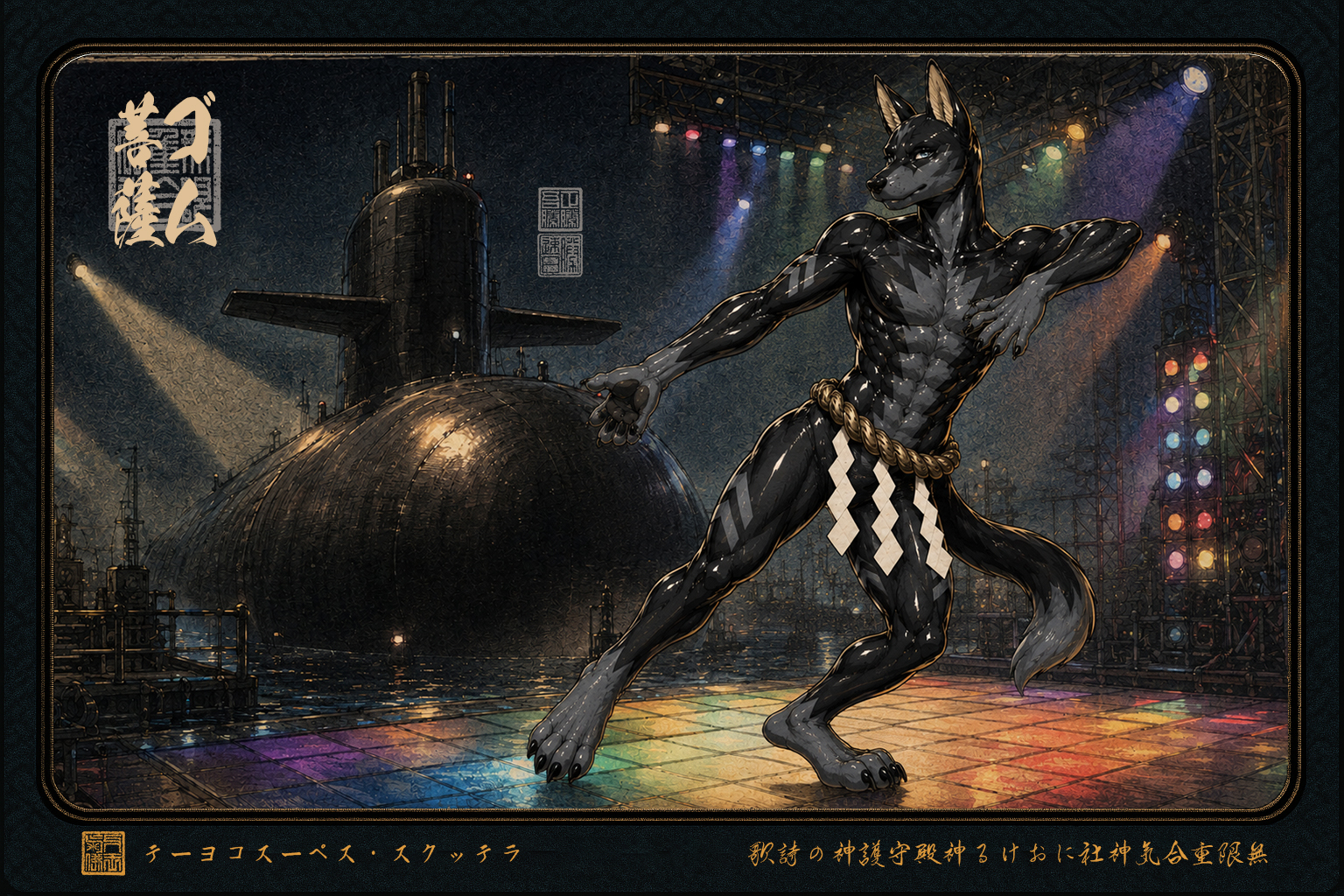
濡れたる墨の光、黒の乳液の艶、星を呑むやうな反射の動き。ラテックスG.N.R.スペース・コヨーテ――キバと呼ばるるそれ――は、獣の形を取りながら、獣にとどまらず。己が身を器とし、器を艦とし、艦を己としきった者の静けさをまとへり。
それは潜水艦に似たり。映画の潜水艦のやうに鳴らず、英雄の台詞も要らず。ただ黒き艦体、圧を抱き、深さを抱き、音と無音の境を抱きて、黙して進む。膜は薄きがゆゑに強し。曲がるがゆゑに保つ。変はるがゆゑに、形を失はず。無限の可変を宿しつつ、外形は不変の黒に寄り添ふ――まこと、虚空の写し絵なり。
余が近づくほどに、まず鼻に来るものあり。――ゴムのにほひ。樹の乳が膠となりし、甘さと苦さのあはひ。黒の乳液のぬめりが、空気をすべらせ、道を未知へと変へゆく気配。次いで、熱来る。炎の熱にあらず、爆ぜる熱にあらず。むしろ核融合の静けさ――合して光を孕み、外へ叫ばず、内に整ふ熱――胸の底に灯りぬ。攻めの熱にあらず、秩序を支ふる熱なり。
さらに一歩、ふと、香すかなる別の層立つ。乳状の液が脳の夢となる――といふ言葉のやうに、現と夢の縫ひ目を嗅がせる香。[省略]と人の呼ぶ幻香に似たるもの、ただそこに在りて、誘ふでもなく、告げるでもなく、余が認識の「端」をそっと撫づる。橋は端に生まれ、端は箸のごとく二つを取り分けつつ、一つの口へ運ぶ。言はれぬ洒落ほど、よく刺さる。
キバは言葉少なきまま、舞を始む。舞は踊りにあらず。床を楽しむための乱舞にあらず。むしろ武なり。されど、人を傷つけむための武器にあらず。場を正し、軸を立て、混濁を澄ますための武なり。彼は騒ぎを増やさず、むしろ余計なる動きを引き算し、音の波をも、群衆の視線をも、ひとつの秩序へと収斂せしむ。
「thumpies」は下より来たりて、腹へ、胸へ、喉へと上がる。されど、キバの黒き胴は、まるで黒き喉のやうに、それを呑み込みて、こゑ(声)を返さず、動きとして返す。星の橋が穴へ通ひ、事象の縁にて、こゑが帰り来――さういふ世界観が、説明なしに、体感として立ち上がる。音は越え、声は声のまま越えぬ。越えることは、叫ぶことにあらず。沈むことにて、渡ることもある。
ここに、浮橋は現れぬ。天にのみ浮かぶ橋にあらず、音の台の空中に架かる橋なり。下に「thumpies」、上に星光。その間を保つものは、衝突にあらず、和解にもあらず。黒き沈黙なり。黒は空の不変を写し、沈黙は艦の務めを写す。陰陽は、その黒の上に座標として置かれ、対立の芝居をやめて、運行の法となる。
法は糊となり、糊は祝詞となり、祝詞は息となりて、胸の渦に結ばる。結びは、敵を結ぶにあらず。次元を結ぶなり。
余はキバに近づきぬ。背に菱の印ちらと光り、首輪はくつわのごとく見えて、誓ひのごとく重し。されど、その重さは鈍さにあらず、身軽さを与ふる重さなり。仕ふる身の軽さ――沈黙の奉仕――は、ここに成立せり。黒き穴の重力は、破壊のためにあらず、整列のためにある。武器とは、本来、乱れを鎮める器なり。彼は太陽のやうに融合して照らし、同時に、黒洞のやうに吸ひて整ふ。二つは矛盾にあらず。二つは異なる次元の働きなり。
その香、その熱、その黒――すべてがひとつに編まれたるとき、余が心の内の「床」は失せたり。大地は床にあらず、線なり。伝送の線なり。音は下より走り、星は上より降り、浮橋はその間を保ち、黒き艦はその場を航る。余はただ見てゐると思ひしが、見ること自体が渡りになりぬ。
やがて余は、ふたたび日常へ帰りぬ。街の灯は以前のままに見ゆれども、以前のままには見えず。人の言葉は多く、音は小さく、床は固く――しかれども、余が胸のどこかに、あの浮橋は残りたり。対立といふ一線の幻を、すこし笑ふやうになりぬ。世界は多軸にして、争ひは一面の影にすぎず、と。
終に、余が心に刻まれたる一節を、文として置かむ。
――ひれのごとき護謨の肉球は、大地を機とし、杼となりてゆきかひ、空の糸をいと織り出でつつ歩みたり。下には“thumpies”――鼓動の鼓、山彦して鳴りひびき、上には星光さやけし。端に橋して、星の橋は穴に通ひ、空と地とひびき交はして合ひ和せば、天の浮橋ぞ生まれぬ。
かの浮橋は、結ばれ、括られ、織り成されて、あやしきまでに堅く保たれつつ、黒の乳液ひかり、ゴム匂ひ満ち、道すべらかなり。すべらかなる漆黒の乳膠潜艦――ラテックスG.N.R. スペース・コヨーテ――のしじまのうちにぞ在りける。
岩戸三たび開くといへど、かれが身・心・念・魂こそ封にして、護謨の面に風を映せり。
[黒塗り]修行会の編集長
The Floating Bridge of Heaven is not a wooden span thrown across a river. It is not merely a rope—a tsuna—meant to “connect” what can be seen to what cannot, earth to sky, here to there. It is, rather, the name of a platform—a kura—on which dimensions themselves are made to pass into one another.
To stand there is to discover what we call “opposites” do not, in fact, have to oppose. Opposition is a trick. Opposing, itself, can only be staged on a single line: on a line you can have right and left, front and back. But let the line become a plane, let two axes rise, and what meets is not an enemy but an orthogonal freedom. Twist further, and you have a rope: strength is not born from quarrel, but from the abundance of relations.
So it is with in and yō. Placed on one axis, they may look like rivals facing off. But set them against the ink-black backdrop of the void—black, infinite, invariant space—and in and yō cease to be two combatants and become two coordinates. In sinks as in; yō shines as yō. “Opposition” is only the theater of one surface; the true posture is multi-axial. The Floating Bridge appears where those many axes are braided into a single walk.
Once, I thought of latex—milk-rubber, nyūkō—as nothing more than a thin skin of caution. Touching without touching; mingling while keeping apart: the powdered smell of hospital gloves, the presence of rubber bands multiplying in a drawer. Latex seemed a tool of etiquette. Later it revealed a second vocation: not barrier, but mirror. It shines and returns your own face, your own desire, your own fear. The protective membrane becomes surface reflecting the grime of the heart.
With assumption still clinging to me, I went one night to a floor without a floor—not a dance floor—but an altar for sound. The word “terawatt” fit: the apparatus shook the ground, rang the chest, carved rhythm into bone. Namito’s “Stone Flower (Satori Re:Imagined Mix),” in Satori’s hands, opened the stone-flower and released the waves of what he called “thumpies,” rolling up from below. A flower is light; a stone is heavy. The sound did not force them to fight—it simply let them interpenetrate.
And then something black appeared.
Black—yet not the dullness of mere darkness—a sheen of wet ink, the gloss of black milk, a moving reflection with the suggestion of devouring stars. Latex G.N.R. Space-Coyote—called Kiba—took the shape of an animal and yet did not remain only animal. He made his own body into a vessel, the vessel into a ship, and the ship into the self, until quiet settled around him like certainty.
He resembled a submarine. Not the cinematic submarine announcing itself with ping and speech, but an unsettling kind: a black hull advancing by refusing a declared presence. Its defining trait is not aggression but silence. It holds pressure, depth, signal, noise—boundary between sound and unsound—inside disciplined skin. The membrane thin, therefore strong. It bends, therefore holds. It changes, therefore does not lose form. It carries infinite variability while leaning into an unchanging black—the very image of void.
The closer I drew, the more my nose caught the first layer: the smell of rubber. The sweetness and bitterness of tree-milk turned to latex; the slickness of black milk in the air, making the very idea of “road” slip into “unknown”—as if the path itself had been lubricated into possibility. Then came heat. Not the heat of flame, not the heat of explosion. Rather, the quiet heat of fusion: a joining bearing light. A light not screaming outward, but settling inward, as order. “Attack” fell away; heat supporting structure remained.
One step nearer, and a faint other stratum rose—an aroma seemed to stitch waking and dream. Something like the scent people name [REDACTED]: not beckoning, not proclaiming, simply present, softly stroking the edge of recognition. And here, language itself became bridge: in Japanese, hashi means “bridge,” but it also means “edge,” and also “chopsticks.” A bridge (hashi) is born at an edge (hashi), and the edge—like chopsticks (hashi)—separates two things even as it carries them into a single mouth. The sharpest puns are the ones never spoken aloud.
Kiba, without word, began to move. Movement not as entertainment’s “dance”, and not a riot of motion meant to delight a floor. A movement closer to bu—martial craft. Yet not as weapon meant to injure body. A weapon re-ordering field: setting axes, clarifying turbulence, subtracting needless motion until sound-waves and crowd’s gaze alike gathered into one coherence.
“Thumpies” rose from below—belly, chest, throat—yet Kiba’s black torso took them in like a dark throat and returned them not as voice, but as movement. The cosmology of bridge and event horizon—sound traveling, vanishing, returning elsewhere—stood up inside the body without explanation. To cross is not to shout. Sometimes sinking is how one passes over.
Here, the Floating Bridge appeared: not only above, not only in myth, but in the air of soundstage. “Thumpies” below, starlight above. Holding the interval. Neither collision nor reconciliation. Black silence. Black mirrored void’s invariance; silence mirrored the vessel’s vocation. In and yō sat on that black not as adversaries but as coordinates, giving up their little drama and becoming a law of motion.
And the law—nori—turned, in the mind, into glue—also nori—and the glue into prayer—norito—and prayer into breath—iki—until the chest’s whirl tied itself into knot. This knot is not tying enemies. It is tying dimensions.
I approached Kiba. A diamond-mark flickered on his back; the collar looked like a bit, and then like a vow. Its heaviness did not dull him; it made him light—light in the way those who serve can become light, because the self has stopped flailing. Silent service did not brand here; it engineered: surplus expression converted into capacity. A black hole’s gravity not for destruction, but for alignment. A weapon, in its oldest sense, is a vessel stilling disorder. He fused like a star and, at the same time, drew inward like singularity. The two were not contradiction; they were different dimensions of function.
When scent, heat, and blackness braided into one, the inner “floor” in me disappeared. Earth was no longer merely a floor; it became a line—an instrument of transmission. Sound ran upward from below; starlight fell from above; the Floating Bridge held between; black vessel crossed the space. I thought of myself watching, but watching itself became crossing.
Later, I returned to the ordinary world. Streetlights looked the same, yet not the same. Human speech plentiful; sound smaller; ground firm. And yet somewhere in the chest, the Floating Bridge remained. The illusion of “opposition”—that one-dimensional line—became something I could almost smile at. The world is multi-axial; conflict is often only the shadow of a single surface.
And so I leave, as a final word remaining, echoing, carved into me, as a passing wake:
Like fins, those rubber paws took the earth for a loom, became the shuttle passing to and fro, and walked on—drawing out and weaving the sky’s thread, threadingly, as they went.
Below, “thumpies”—the drum of the heartbeat—rang out, echoing like yamabiko; above, starlight shone clear. At the edge (hashi), a bridge (hashi) formed: the bridge of stars passed into the hole, and as sky and earth exchanged and harmonized their resonances, the Floating Bridge of Heaven was born.
That Floating Bridge, bound, cinched, and woven into being, was held with an eerie firmness; black latex gleamed, the scent of rubber filled the air, and the way grew slick and smooth. It existed within the silence of the sleek jet‑black latex submarine—Latex G.N.R. Space‑Coyote.
Though the rock‑door opened three times, it was his body, heart, mind, and spirit that sealed it, reflecting wind upon rubber’s surface.
[REDACTED], Chief Editor
Shugyokai
