

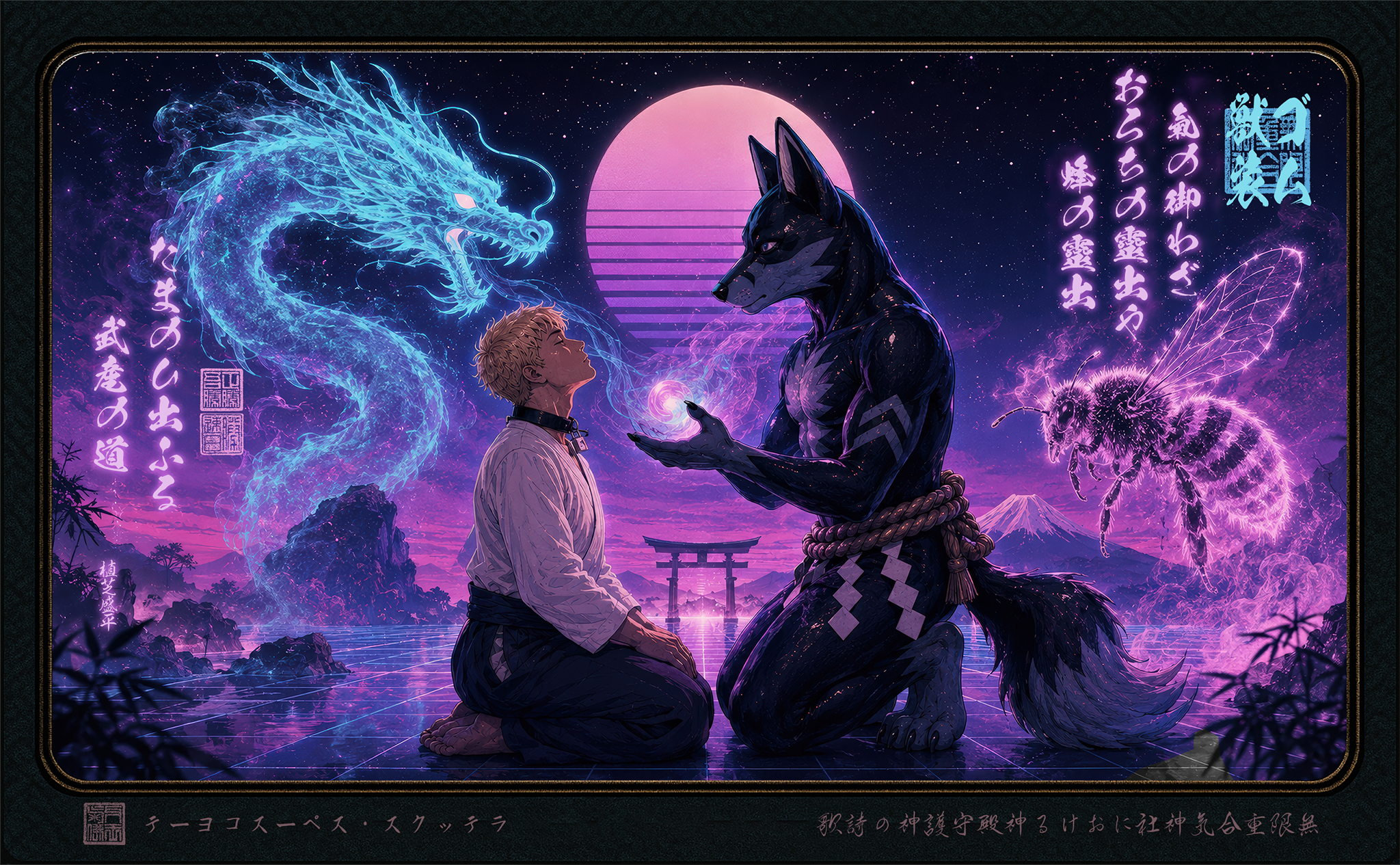
解説
この第126首は、原文「気の御わざ/おろちの靈出や/蜂の靈出/たまのひ出ふる/武産の道」を、気(き)の神業が発動するとき――重くうねる“おろち(大蛇)”の霊がせり上がり(靈出=ひで)、軽く震える“蜂”の霊が弾け出る。そこで“たま(魂/玉)”の“ひ(火・日)”が湧きふるえ(出で+振る)、それこそが〈武産(たけむす)の道〉だ――と読むページです。中二句のやは切れ字で像を強調、靈出(ひで)は「霊が顕れる」古表記、たまのひは魂/玉 × 火・日の掛詞的凝縮、出ふるは出で+振るで魂振(たまふり)の陰影を帯びます。結句の武産は開祖が重んじた「宇宙法則と合して技が自ずと生まれる」生成の道を名指しする語だ、と本文は筋道立てて解き明かしています。
植芝盛平の六つのプライマーに糸戻しすると、構図はこう立ち上がる。プライマーの第一原理〈武=宇宙原理〉—気の御わざとして宇宙的“発生(結び)”を軸に置く。プライマーの第二原理〈神や人との合気〉—おろち(重厚・蠢動)/蜂(軽捷・振動)という相反モードの“出”を、対神や人の受け・さばきへ和合させる入口。プライマーの第三原理〈心魂一如〉—出(い)で+振る=感受(聴)と所作(振)を同拍で束ねて魂振する芯。プライマーの第四原理〈和合美化〉—重・軽の両相がぶつからず整う美を帰着点に。プライマーの第五原理〈体=道場/心=修業者/修行者/学び手〉—稽古では“重い出”と“軽い出”を一呼吸で聴き分け、ひ(火・日)を曇らせない磨きを反復。プライマーの第六原理〈“至愛”の源に順う〉—気の御わざの発動が生かす方向(至愛)に乗っているかを最上位で点検する。ページの語注(靈出・切れ字や・武産)に沿うこの運転図は、「発(出)→振→生(産)」の直列として読めます。
直前の三首とも自然につながる。第123首の「愛の構え」で広がった“中”に生きる不動が据わり、第124首の「赤白玉/ますみ玉/小戸の神技」で相補の浄め×真澄の映し×禊が整えられ、第125首の「御剣よ すめ(澄め/住め)・光れ(光れ/惹かれ)」で鍛え上げた刃の澄明が宣られた――その地ならしの上で第126首は、“蛇の出”“蜂の出”という対照的な発生を、その澄明のうちに〈たまの“ひ”が出で振る〉へと束ね、武産の道=技が生まれ続ける場に接続せよ、と促している。稽古に引き直せば、(第123首)愛の構えで“中”を保ち、(第124首)真澄に映して濁りを祓い、(第125首)澄み住みつつ光らせた刃で、重/軽の出を魂振に転じ、技を生ませること――それがこのページの要諦です。
口語要約のひとこと
「気のはたらき――大蛇の霊がせり上がり、蜂の霊が弾け、魂の火が湧きふるえて、そこに武産の道がひらける。」
歌法補説――靈出の反復と武産への収束
この第126首で、語注にまだ前景化しきれていない歌法としてまず目立つのは、「の」の畳みかけと「靈出/ひ出」の反復である。五句のうち、第一句「気の御わざ」、第二句「おろちの靈出や」、第三句「蜂の靈出」、第四句「たまのひ出ふる」、第五句「武産の道」まで、「の」が連続して各像を結び、単なる所有ではなく、発出の鎖をつくっている。すなわち、気から御わざへ、おろち・蜂から靈出へ、たまからひ出ふる働きへ、最後に武産の道へと、諸像がばらばらに並ぶのでなく、一つの「生み出し」の流れとして縒り合わされる。この助詞反復は、内容面の結びと形式面の結びとを重ね、歌そのものを生成の呼吸にしている。
第二に、中句には対句・対照の働きが強い。「おろちの靈出や」と「蜂の靈出」は、同じ「Xの靈出」の型を取りながら、片方は大きく、重く、地・水の底から蠢く像、片方は小さく、鋭く、空中に震える像として置かれる。語形は並行し、像は反対へ開くため、ここに大小・重軽・鈍速・地空の対照が生じる。これは単なる動物名の列挙ではなく、気の発現が一つの様態に閉じず、鈍重なうねりにも微細な震動にもなることを、対句のかたちで見せる仕掛けである。「や」による二句切れも、ここでは像を断ち切るだけでなく、まずおろちの重い出を立て、ついで蜂の軽い出を遅れて響かせる拍の差を生む。
第三に、縁語の連鎖が全体を支配している。気・御・靈・たま・ひ・武産は霊的生成の縁語であり、出・振る・産は顕現と生起の縁語であり、おろち・蜂は生類/霊物の縁語である。これらの語群が互いに照り返すため、「おろち」と「蜂」は単なる比喩動物に留まらず、気の御わざに属する霊的運動として読まれる。ことに「出」が第二句・第三句・第四句に響き続けることで、歌の軸は描写から発生へ移り、最後の「産」によってその発生が武の生成原理として受け止められる。
第四に、見立ての働きも強い。抽象的な気のはたらきや武産の生成は、そのままでは目に見えない。そこで歌は、それをおろちのうねり、蜂の震え、たまのひの湧出として見立てる。つまり、武の技が生まれる瞬間を、動物霊と霊火の顕現として視覚化しているのである。この見立てによって、武産は理論語に留まらず、身の奥で立ち上がる気配、皮膚に触れる振動、腹底からせり上がる力として感受される。
また、第二句から第三句の動物霊の並置は、古典和歌でいう厳密な序詞ではないが、働きとしては序詞的である。おろち・蜂の具体像が先に置かれることで、第四句「たまのひ出ふる」と第五句「武産の道」は、抽象語としてではなく、すでに身体化された像として受け取られる。つまり前半の像は後半の道理を導き出す助走であり、「何を言うか」だけでなく、「どの感覚で受けるか」をあらかじめ整える導入となっている。
第五に、「たまのひ出ふる/武産の道」には句またがりと体言止めが働く。第四句の「出ふる」は終止しきらず、第五句「武産の道」へかかって、〈たまのひが出で振る、その道〉という連体的な流れをつくる。しかも結句は「道」という体言で止まるため、説明文のように閉じず、名指された道だけが静かに残る。ここで体言止めは教義的な断定を柔らかくしながら、逆に余韻を深くする。何をなすべきかを命令せず、ただ「武産の道」と置くことで、読者はその道へ身を移すよう促される。
さらに音の面では、は行音と「ひで」の反復が一種の呪的な拍をつくる。蜂(はち)、靈(ひ)、ひ出、振る(ふる)へ続く息の音は、蜂の羽音のような微振動を帯び、同時に「ひ」の霊火を幾度も吹き起こす。靈出(ひで)は字義としては霊の顕現であるが、音の分解では「ひ」が「出る」感覚を繰り返し起こし、第四句の「たまのひ出ふる」でその潜在的な響きが前景化する。これは狭義の古典的掛詞というより、字と音の重なりから生じる掛詞的な余光であり、言霊的な読みによく合う。
なお、この首には、地名を呼び込む歌枕、固定句としての枕詞、また係り結びの文法構造は、狭義には積極的に立っていない。むしろそれらの定型的権威に頼らず、「の」の反復、靈出の畳句、対句、縁語、見立て、句またがり、体言止めによって、短い三十一音の内部に、気の発動から霊の顕現、魂振、武産の道への推移を組み込んでいる。ゆえにこの歌の余韻は、景物の余情というより、発(出)・振・産の運動がまだ終わらず、読者の身中で続いていくような生成の余韻である。
発話行為理論
この歌の発話内容は、単なる命題へ還元しきれない。発話行為(locutionary/ロキューション)の層で見れば、第一句が「気の御わざ」という神聖な作動の場を立て、第二句が重くうねる顕現を切れ字「や」で切り立て、第三句が軽く跳ねる顕現を差し出し、第四句が前半の像を内なる霊火へ折り返し、第五句が全体を「武産の道」として収める。ここでの折り返しは、一・二句→四句、三句→五句という照応の回路であり、「や」の切断と列挙の開き、「たま」「ひ」の掛詞的凝縮によって、意味は直線ではなく反照として組まれている。ゆえに後半は前半をただ継ぐのでなく、前半を読み返させ、像そのものの位相を変えてしまう。
発話内行為(illocutionary/イロキューション)の層では、主眼は事実の報告に置かれない。おろちの重さと蜂の敏さは、気の顕現が取りうる相を例示する像として立てられ、結句でその相が「武産の道」として宣り分けられる。ここで「や」は像を切りながら連結し、列挙を閉じず、武産を定義として固定するのでなく、顕現の型として示す。したがって、この首の発話内行為は、説明・賛嘆・命名・宣示の重なりとして働き、気の発現をどう見るべきかを道として言い当て、稽古と感受の向きを整えつつ、そこへ宗教的な方向を与える。
発話媒介行為(perlocutionary/パーロキューション)の層では、読後に残るものは理解だけでは尽きない。おろちの蠢きがまず身の奥の重みを呼び、蜂の震えが気配の細部を立て、四句の「たまのひ出ふる」でその二相が内的な震えと霊火の湧出へ移り、結句でその震えが「武産の道」として定着する。切れ字と掛詞的多義、そして折り返しの構えが読みを一度で終わらせず、余韻のなかで前半を往還させて再照射するため、理解のみならず、畏れ、昂揚、澄明、生成への同調まで引き起こすところに、この歌の強いパーロキューショナリーな働きがある。
コーダ
この首の「や」は、像を閉じる切れであると同時に、列挙を閉じない開きである。おろちの靈出や――そこで歌は一度、重くうねるものを立てる。しかし、その「や」は「これと、それだけ」と数え終えるための標ではない。蜂の靈出が続くとき、そこには大蛇と蜂という二相だけでなく、なお名づけられていない無数の気の発現が、余白のうちに含まれている。重くせり上がるもの、軽く弾けるもの、沈むもの、ひらめくもの、鳴るもの、黙するもの――そのすべてが、気の御わざの未完の列に属している。
ゆえに「武産の道」は、既に定まった型をたどる道ではなく、いまだ尽くされぬ発生を聴き続ける道である。おろちと蜂は、道の全体を代表するのではない。むしろ、それらは門であり、兆しであり、稽古の身中にひらく最初の二つの響きである。そこから先に、どのような靈出が起こるのかは、心魂一如に澄み、相手と場と宇宙法則へ耳を澄ます者にだけ、その都度、産まれてくる。やが閉じないかぎり、武産もまた閉じない。技は終わった答えではなく、なお生まれようとする祈りである。では、われわれの身のうちで、次に名を持たぬ何が出で振るのだろうか。
English Translation
Commentary
Dōka 126 reads the original text, “Ki no miwaza / orochi no hide ya / hachi no hide / tama no hi idefuru / Takemusu no michi (気の御わざ/おろちの靈出や/蜂の靈出/たまのひ出ふる/武産の道),” in the following way: when the divine working of ki (気) is set in motion, the spirit of the heavy, undulating orochi (おろち), the great serpent, rises forth—hide (靈出); the spirit of the lightly quivering bee bursts out; and there the hi (ひ)—fire, sun, radiance—of the tama (たま), spirit or jewel, wells up and trembles forth. This, precisely, is the path of takemusu (武産). The ya (や) in the middle phrase functions as a cutting word, throwing the image into relief. Hide (靈出) is an old orthographic form meaning “the spirit appears.” Tama no hi (たまのひ) condenses, in a manner akin to kakekotoba (掛詞), spirit/jewel and fire/sun. Idefuru (出ふる) carries the shading of ide + furu (出で+振る), “to come forth” and “to shake,” and so also of tamafuri (魂振), the shaking or quickening of the spirit. The closing phrase takemusu (武産) names what the founder held dear: the generative path in which, by harmonizing with the laws of the universe, technique is born of itself.
When threaded back through Ueshiba Morihei’s Six Primers, the structure rises into view like this. The First Primer, Bu = Uchū Genri (武=宇宙原理), “Bu as Cosmic Principle,” places cosmic emergence—musubi (結び), generative joining—at the center as the divine working of ki (気). The Second Primer, Kami ya Hito to no Aiki (神や人との合気), “Aiki with Kami / Another / Others,” opens the way to harmonizing, in receiving and handling kami and another, contrasting modes of emergence represented by orochi (おろち)—massive, weighty, writhing—and the bee—light, agile, vibrating (though not limited to these modes alone). The Third Primer, Shin-kon Ichinyo (心魂一如), “Heart-mind and Spirit Inseperable,” gives the core of tamafuri (魂振): ide (出で), coming forth, and furu (振る), shaking or moving, binding receptivity—listening—and action—movement—into a single beat. The Fourth Primer, Wagō Bika (和合美化), “Harmonizing and Beautifying,” makes the beauty in which heavy and light do not collide but come into order the point of return. The Fifth Primer, Karada = Dōjō / Kokoro = Shugyōsha / Shugyōsha / Manabite (体=道場/心=修業者/修行者/学び手), “Body as Dōjō, Heart-mind as Learner,” turns practice into the repeated polishing by which one discerns, in a single breath, the “heavy emergence” and the “light emergence,” without clouding the hi (ひ), the fire-sun radiance. The Sixth Primer, Shiai no Minamoto ni Shitagau (“至愛”の源に順う), “Following the Source of Supreme Love,” asks at the highest level whether the activation of ki no miwaza (気の御わざ), the divine working of ki, is moving in the direction that gives life. This operating diagram, following the page’s notes on hide (靈出), the cutting word ya (や), and takemusu (武産), may be read as a direct sequence: emergence—de (出)—shaking—furu (振)—birth—musu (産).
It also connects naturally with the three immediately preceding poems. In Dōka 123, the immovability that lives within the “center” opened by ai no kamae (愛の構え), the posture of love, was established. In Dōka 124, the complementary purification of the red and white jewels, the reflecting clarity of the pure jewel, and the misogi of the divine working of the small inlet—akashiro-dama / masumi-dama / odo no kamuwaza (赤白玉/ますみ玉/小戸の神技)—were brought into order. In Dōka 125, the clarified blade was proclaimed through mitsurugi yo sume / hikare (御剣よ すめ・光れ), where sume (すめ) resonates as both “be clear” and “dwell” (澄め/住め), and hikare (光れ) as both “shine” and “be drawn” (光れ/惹かれ). Upon that prepared ground, Dōka 126 gathers the contrasted emergences of “the serpent’s coming forth” and “the bee’s coming forth” into tama no hi ga idefuru (たまのひが出で振る), the spirit’s fire-sun trembling forth within that clarity, and urges us to connect it to takemusu no michi (武産の道), the path where technique continues to be born. Recast into practice, the essence of this page is this: maintain the “center” through the posture of love, as in Dōka 123; reflect all things in true clarity and purify the turbidity, as in Dōka 124; with the blade that has been clarified, dwells in clarity, and shines, as in Dōka 125, turn the heavy and light modes of emergence into tamafuri (魂振), and allow technique to be born.
A one-line colloquial summary
“The working of ki—the serpent spirit rises, the bee spirit bursts forth, the fire of the spirit wells up and trembles, and there the path of takemusu opens.”
Supplement on poetic technique: The repetition of hide and the convergence into takemusu
In this Verse 126, the first poetic device not yet fully foregrounded in the word notes is the piling up of no (の) and the repetition of hide / hi-de (靈出/ひ出). Across all five phrases—ki no miwaza (気の御わざ), orochi no hide ya (おろちの靈出や), hachi no hide (蜂の靈出), tama no hi idefuru (たまのひ出ふる), and takemusu no michi (武産の道)—the particle no (の) links each image to the next. This is not mere possession; it forms a chain of emanation. From ki (気) to divine working, from serpent and bee to spirit-emergence, from tama (たま) to the working of hi idefuru (ひ出ふる), and finally to the path of takemusu (武産), the images are not placed side by side at random. They are twisted together as one current of “bringing forth.” This repetition of the particle overlays formal joining with the joining enacted in the poem’s content, making the poem itself breathe with generation.
Second, the middle phrases strongly enact parallelism and contrast. Orochi no hide ya (おろちの靈出や) and hachi no hide (蜂の靈出) share the same pattern, “X’s spirit-emergence,” while opening into opposite images. One is large, heavy, writhing up from the depths of earth and water; the other is small, sharp, vibrating in the air. The verbal form is parallel, but the images diverge. Thus there arises a contrast of large and small, heavy and light, slow and swift, earth and sky. This is not a mere list of animal names. It is a device that shows, through the shape of parallel phrasing, that the manifestation of ki (気) is not confined to a single mode: it may become a dense, weighty surge, or a fine, subtle vibration. The second-phrase cut created by ya (や) does more than sever the image. It first establishes the heavy emergence of the serpent, then allows the lighter emergence of the bee to resound after it with a shifted beat.
Third, the whole poem is governed by a chain of associated words, an engo (縁語). Ki (気), the honorific mi (御), rei / hi (靈), tama (たま), hi (ひ), and takemusu (武産) belong to the vocabulary of spiritual generation. De / ide (出), furu (振る), and musu (産) belong to the vocabulary of manifestation and arising. Orochi (おろち) and hachi (蜂) belong to the realm of living beings and spirit-creatures. Because these word groups mutually illuminate one another, the serpent and the bee remain more than animal metaphors. They are read as spiritual motions belonging to the divine working of ki (気). Especially because “emergence,” de / ide (出), continues to sound through the second, third, and fourth phrases, the axis of the poem shifts from description to genesis; and in the final musu (産), that genesis is received as the generative principle of bu (武), the martial way.
Fourth, the operation of mitate (見立て), poetic “seeing-as” or figuration, is also strong. The abstract working of ki (気) and the generative principle of takemusu (武産) are not visible in themselves. The poem therefore sees them as the serpent’s undulation, the bee’s tremor, and the welling forth of tama no hi (たまのひ), the spirit’s fire-sun. In other words, it visualizes the moment in which martial technique is born as the manifestation of animal spirits and spiritual fire. Through this mitate (見立て), takemusu (武産) does not remain a theoretical term. It is felt as a sign rising from the body’s depths, a vibration touching the skin, a force pressing upward from the bottom of the belly.
The juxtaposition of animal spirits from the second to the third phrase is not, in the strict classical sense, a jo-kotoba (序詞), or preface phrase. Yet it performs a preface-like function. By placing the concrete images of serpent and bee first, the fourth phrase, tama no hi idefuru (たまのひ出ふる), and the fifth phrase, takemusu no michi (武産の道), are received not as abstractions but as images already embodied. The images of the first half become a running approach that draws out the principle of the latter half. They prepare not only “what is to be said,” but also “through what sensation it is to be received.”
Fifth, ku-matagari (句またがり), phrase-overflow, and taigendome (体言止め), ending on a noun, are at work in tama no hi idefuru / takemusu no michi (たまのひ出ふる/武産の道). The fourth phrase, idefuru (出ふる), does not come to full closure. It leans into the fifth phrase, takemusu no michi (武産の道), creating an attributive flow: “the path in which the hi (ひ) of the tama (たま) comes forth and trembles.” And because the final phrase stops on the noun michi (道), “path,” it does not close like an explanatory sentence. The path that has been named remains quietly present. Here taigendome (体言止め) softens doctrinal assertion while deepening the resonance. Rather than commanding what one must do, the poem simply places before us takemusu no michi (武産の道), and in doing so invites the reader to move bodily into that path.
On the level of sound, the ha-row sounds and the repetition of hide (ひで) create a kind of incantatory beat. The breath-sounds running through hachi (蜂), hi (靈/ひ), hide (靈出), and furu (振る) carry a fine vibration, like the wingbeat of a bee, while at the same time repeatedly fanning the spiritual fire of hi (ひ) into motion. In literal meaning, hide (靈出) is the manifestation of spirit; but when heard through its sound, it repeatedly awakens the sense that hi (ひ) is “coming forth,” and in the fourth phrase, tama no hi idefuru (たまのひ出ふる), that latent resonance comes fully into the foreground. This is less a classical kakekotoba (掛詞) in the narrow sense than an afterglow of wordplay born from the overlap of character and sound, and it accords well with a kotodama (言霊) reading.
Strictly speaking, this poem does not actively rely on an utamakura (歌枕), a place-name charged with poetic association; nor on a fixed makurakotoba (枕詞), pillow word; nor on the grammatical structure of kakarimusubi (係り結び), bound-particle conclusion. Rather than leaning on those established classical authorities, it builds into the short space of thirty-one sounds a movement from the activation of ki (気), to the manifestation of spirit, to tamafuri (魂振), and then to takemusu no michi (武産の道), using instead the repetition of no (の), the repeated phrase hide (靈出), parallelism, contrast, engo (縁語), mitate (見立て), phrase-overflow, and noun-ending closure. Thus the poem’s lingering resonance is not so much the emotional aftertone of a landscape. It is the generative resonance of a movement—emergence, shaking, birth—that has not ended, but continues within the reader’s own body.
Speech Act Theory
The utterance-content of this poem cannot be reduced to a simple proposition. On the level of the locutionary act, the first phrase establishes the sacred field of operation called ki no miwaza (気の御わざ), the divine working of ki (気). The second phrase raises up a heavy, undulating manifestation and cuts it sharply with the cutting word ya (や). The third phrase offers a light, springing manifestation. The fourth phrase folds the images of the first half back into the inner spiritual fire, and the fifth phrase gathers the whole as takemusu no michi (武産の道). This folding-back forms a circuit of correspondence: the first and second phrases turn toward the fourth, and the third phrase turns toward the fifth. Through the cutting and opening force of ya (や), through the openness of enumeration, and through the condensed polysemy of tama (たま) and hi (ひ), meaning is organized not as a straight line but as reflection and return. The latter half therefore does not merely continue the first half; it makes us reread it, changing the very plane on which the images themselves are received.
On the level of the illocutionary act, the main purpose is not factual report. The heaviness of the serpent and the quickness of the bee are set forth as images that exemplify the possible modes of ki (気) in manifestation, and in the closing phrase these modes are declared and distinguished as takemusu no michi (武産の道). Here ya (や) cuts the image while also connecting it; it leaves the enumeration open, and does not fix takemusu (武産) as a closed definition, but shows it as a pattern of manifestation. Therefore the poem’s illocutionary force works as a layering of explanation, praise, naming, and proclamation. It says what the manifestation of ki (気) is to be seen as; it names that seeing as a path; it sets the direction of practice and receptivity; and it gives that direction a religious orientation.
On the level of the perlocutionary act, what remains after reading is not exhausted by understanding. The serpent’s writhing first summons a weight in the depths of the body. The bee’s vibration sharpens the subtle edges of presence. In the fourth phrase, tama no hi idefuru (たまのひ出ふる), these two modes shift into an inward trembling and the welling forth of spiritual fire, and in the closing phrase that trembling settles as takemusu no michi (武産の道). The cutting word, the kakekotoba-like polysemy, and the posture of folding-back do not allow the reading to end after a single pass. In the resonance they create, the first half is traversed again and illuminated anew. Thus the poem’s strong perlocutionary force lies in the fact that it produces not only comprehension, but also awe, uplift, clarity, and attunement to generation.
Coda
The ya does not merely cut; it opens. Orochi no hide ya—there the poem raises the heavy serpent-surge into view, but it does not seal the enumeration around serpent and bee alone. When hachi no hide follows, the bee’s quick vibration does not complete a closed pair. It reveals that the list has only begun. Serpent, bee, and not only these: the dense rising, the fine trembling, the sudden spark, the silent pressure, the turn of breath, the hidden answering of body to world. The ya leaves the gate ajar, and through that opening the uncounted forms of ki’s august working continue to arrive.
For this reason, takemusu no michi is not the path of finished forms, but the path of inexhaustible arising. The serpent and the bee are not the whole doctrine. They are signs placed at the threshold: one coiling up from the depths, one flashing in the air, both teaching that manifestation is never single, never exhausted, never finally named. In practice, this means that technique is not imposed upon life; it is born where listening has become movement, where the spirit’s fire is roused without violence, where the unclosed enumeration of the world enters the body and becomes right action. So long as ya remains open, takemusu remains alive. The path does not end in the forms we know; it waits in the next emergence.
References
Austin, J. L. (1962). How to do things with words. Oxford University Press.
Breen, J., & Teeuwen, M. (2010). A New History of Shinto. Wiley‑Blackwell.
Brower, R. H., & Miner, E. (1961). Japanese Court Poetry. Stanford University Press.
DIGITALIO. (n.d.). 産霊(読み)ムスヒ. Retrieved November 25, 2025, from https://kotobank.jp/word/%E7%94%A3%E9%9C%8A-641713
DIGITALIO. (n.d.). 精選版 日本国語大辞典 「火産霊」の意味・読み・例文・類語. Retrieved November 25, 2025, from https://kotobank.jp/word/%E7%81%AB%E7%94%A3%E9%9C%8A-2082775
Frellesvig, B. (2010). A history of the Japanese language. Cambridge University Press. https://doi.org/10.1017/CBO9780511778322
Greenhalgh, M. (2003). Aikido and spirituality: Japanese religious influences in a martial art (Master’s thesis). Durham University e-Theses. https://etheses.dur.ac.uk/4081/
Hardacre, H. (2017). Shinto: A History. Oxford University Press.
Kasulis, T. P. (2004). Shinto: The Way Home. University of Hawai‘i Press.
Kameyama Jinja [亀山神社]. (n.d.). 神社や神様のまめ知識: 日常の生活に溶け込んだ日本の文化をご紹介します [Trivia about Japanese shrines and gods: Exploring the Japanese culture that blends seamlessly into daily life]. Retrieved November 25, 2025, from https://www.kameyama-jinja.com/mamemusuhi.html
Kokugakuin University. (n.d.). 火之迦具土神 [Hikagutsuchi Kami]. In 神名データベース [Divine name database]. Retrieved November 25, 2025, from https://kojiki.kokugakuin.ac.jp/shinmei/hinokagutsuchinokami/
Labrune, L. (2012). The Phonology of Japanese. Oxford University Press.
Mikunimusubi. (2019, April 17). 産霊(むすひ) [Musuhi (Mu Su Hi)]. Mikunimusubi.com. Retrieved November 25, 2025, from https://mikunimusubi.com/%E7%B5%90%E3%81%B3%E3%81%AE%E7%94%B1%E6%9D%A5%EF%BC%9D%E7%94%A3%E9%9C%8A%E3%82%80%E3%81%99%E3%81%B2/%E7%94%A3%E9%9C%8A%E3%82%80%E3%81%99%E3%81%B2/
National Institute for Japanese Language and Linguistics [NINJAL]. (2017). 日本語歴史コーパス 短単位規程集 Ver.1.0(鎌倉時代編). https://clrd.ninjal.ac.jp/chj/doc/morph_kamakura_v1_0.pdf
Okazaki, Y. (2025). タカミムスヒ詳論(その9)「ムスヒ」とはどういう意味か. note.com. Retrieved November 25, 2025, from https://note.com/spinozaist1/n/nb0a90f93628d
Philippi, D. (1968). Kojiki. University of Tokyo Press.
Shirane, H. (2005). Classical Japanese: A Grammar. Columbia University Press.
Shimazu, N. (n.d.). Mikoto. In Encyclopedia of Shintō [EOS]. Kokugakuin University. Retrieved October 17, 2025, from https://d-museum.kokugakuin.ac.jp/eos/detail/?id=9949
Space-Coyote, L. G. N. R. (2025). ひふみ祝詞; Hifumi Norito. Shugyokai.org. Retrieved December 15, 2025, from https://shugyokai.org/修行-shugyo/稽古-keiko/禊-misogi/祝詞-norito/hifumi-norito/
Takahashi, H. (1986). 武産合気 ー合気道開祖・植芝盛平先生口述 [Takemusu Aiki: The Oral Teachings of Aikido Founder, Ueshiba Morihei Sensei]. 白光真宏会出版本部 [Byakko Shinko-kai Shuppan Honbu].
Takahashi, K. (2024, January 3). 結ぶの語源、産霊(むすひ)[Musuhi, the etymological origin of ‘musubu’ (to bind/tie)]. Nanobrand. Retrieved November 25, 2025, from https://nanobrand.co.jp/blog/2024/01/03/1006/
Ueshiba, M. (1977). 合気道奥義(道歌)(S. Abe, Ed.). 阿部, 醒石. Retrieved from http://www.asahi-net.or.jp/~yp7h-td/douka.htm
Ueshiba, M. (2005). Takemusu Aiki: Lectures of Morihei Ueshiba. Aikido Journal. https://aikidojournal.com/2005/04/07/takemusu-aiki-lectures-of-morihei-ueshiba-founder-of-aikido-1/
Vovin, A. (2003). A Reference Grammar of Classical Japanese Prose. RoutledgeCurzon.
Yachiyo Aikikai. (2011, Feb 17). 魂の霊出(ひで)(blog note on reading). Retrieved from https://yachiyoshiaikikai.sblo.jp/article/43468063.html
Appendix I: Change Modification Log
06 SEP 26 - Applied Primer 2's inclusion of kami in commentaries. 27 AUG 26 - Added Takahashi (1986) note.23 JUL 26 - Minor adjustment, leaning again toward spirit to degloss soul, which is out of alignment with Buddhist/Shintō practices and understanding.09 JUL 26 - Minor update to translation.08 JUL 26 - Added additional poetics analysis; updated formatting; corrected reference order and citation for Ueshiba (2005); added codas in Japanese and English.23 MAY 26 - Updated citation style; improved Speech Act Analysis; fixed typo in six primers application; clarified hifumi relation.11 APR 26 - Updated references; implemented Phase V Speech Acts (Austin, 1962) analysis added in Japanese.24 DEC 25 - Updated translation to align functional poetics (i.e., kami-no-ku to shimo-no-ku fold around ordered scaling top-to-bottom across waka).21 DEC 25 - Phase V styling applied to waka.16 DEC 25 - Updated Shimazu (n.d.) reference for clarity.15 DEC 25 - Updated with ひふみ祝詞 (Hifumi Norito) references.25 NOV 25 - Updated notes on 霊 and its Shintō pronunciation 「ひ」in usage.22 NOV 25 - Phase IV completion; commentary added.17 OCT 25 - Phase III completion.14 APR 20 - Initial notes transferred.